Cardiac Device Implantation Ghaziabad | Cardiac Device Implantation Treatment in Delhi NCR
Dr. Vivek Kumar is a leading Cardiac Device Implantation Doctor in Ghaziabad, Delhi NCR practising at Max Super Speciality Hospital, Vaishali and provides advanced Cardiac Device Implantation Treatment in Delhi NCR.
Cardiac Device Implantation Treatment
When there is an irregular heartbeat, a cardiac device is implanted to help control the heartbeats and protect against heart rhythm abnormalities. The implantable cardioverter-defibrillator (ICD) is designed to monitor heart rhythm continuously 24 hours a day, 365 days a year. The implantable Cardioverter-defibrillator (ICD), a small battery-powered device, is used to detect and treat heart arrhythmias and to slow down fast heartbeats (Tachycardia). An ICD uses an electric shock to re-establish a regular heart rhythm and to continuously monitor heartbeats.
This device is used to assist the heart ventricles in resuming their normal function after an abnormality. If your doctor discovers that you have an extremely rapid heartbeat that causes ventricular tachycardia, ventricular fibrillation, or both, he or she may recommend an ICD implant procedure. Arrhythmia (irregular heart beat) due to weak heart muscle is another common indication.
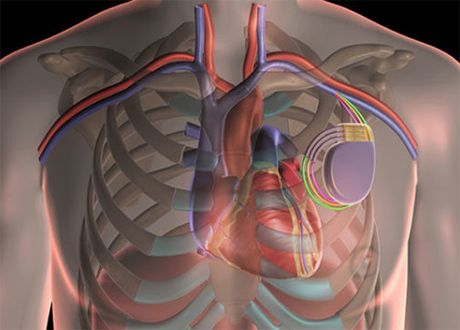
Dr. Vivek Kumar is among the best Cardiac Device Implantation Doctors in Ghaziabad and Delhi NCR, practising at Max Super Speciality Hospital, Vaishali, and is fully equipped to handle even the most complex cardiac device implantation procedures.
Who may benefit from Cardiac Device Implantation?
- Patients with coronary artery disease or prior heart attack leading to heart muscle weakness
- Patients with an enlarged heart muscle (cardiomyopathy)
- Patients with certain genetic conditions that cause very fast heart rhythms (e.g., Long QT Syndrome)
- Other conditions that have weakened the heart muscles and predispose to life-threatening arrhythmias
Diagnosis before ICD Implantation
The following tests may be required before the procedure:
- ECG – Electrocardiography: Measures the electrical signals produced by the heart and helps determine whether the heart rhythm is fast, slow, or normal.
- Echocardiography (ECHO): Uses sound waves to create images of the heart in order to assess its structure, function and rhythm.
- Holter Monitoring: A portable device worn for 1–2 days to record continuous heart rhythm without missing any episode. Sensors are attached to the chest and linked to a small battery-powered recorder.
- Electrophysiology Study (EP Study): Performed by a specialist to locate the precise area of the heart causing the irregular heartbeat. Flexible catheters with sensors are inserted through blood vessels into the heart to map its electrical activity.
After admission and during the procedure
- Fasting for 8 hours before the procedure is required to ensure safety and fewer complications.
- The cardiologist will advise which medications should be continued or stopped prior to the procedure.
- An intravenous (IV) line is inserted in the hand or forearm; the procedure is usually performed under local anaesthesia with mild sedation.
- Using X-ray (fluoroscopic) guidance, the doctor inserts leads through a vein near the collarbone into the heart. The leads are connected to the ICD generator, which is placed under the skin near the collarbone.
- The procedure typically takes a few hours.
- After implantation the device is programmed to detect and treat abnormal heart rhythms.
- Most patients are discharged the next day. Mild swelling and tenderness at the implant site may persist for a few days.
Precautions after the procedure
- Pain relievers may be prescribed as needed. Avoid sudden jerky movements of the left arm above the shoulder for about two months so that the leads remain securely in place until fully healed.
- Driving restrictions will be advised by your cardiologist before discharge.
- Avoid the following for one month after the procedure:
- Heavy exercises involving the shoulder
- Swimming, golf, bowling, tennis, etc.
- Weight lifting